
Are Animals Right-Pawed or Left-Pawed?
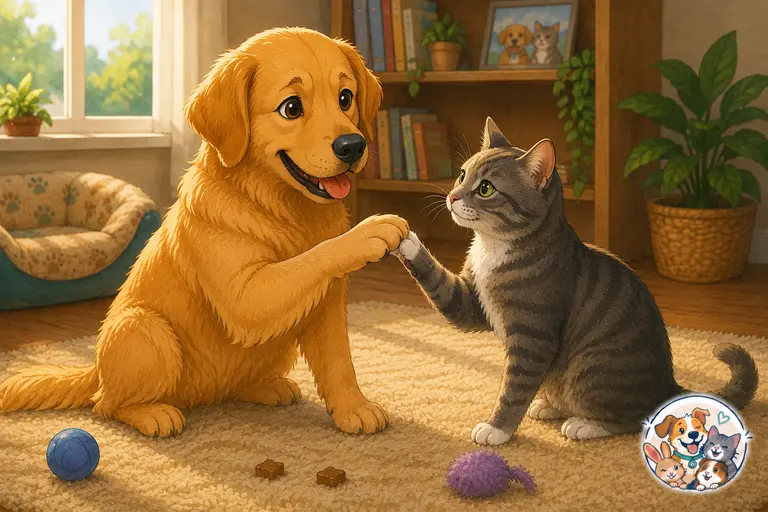
Are Animals Right-Pawed or Left-Pawed?
When we talk about being right-handed or left-handed, we immediately think of humans.
However, we are not the only ones to have a preference for one side of the body. Many animals naturally use one paw, wing, or even fin more often than the other.
You may already have asked your dog to give you a paw. Have you noticed that they often offer the same one?
It may not be a coincidence.
So, is your dog, your cat… or even your parrot right-pawed or left-pawed?
The answer may surprise you.
Do Animals Have a Dominant Paw?
Yes.
As in humans, the brains of animals are divided into two hemispheres that perform different functions.
This organisation can influence their movements and lead them to use one side of the body more often than the other.
Scientists call this lateralisation.
In other words, some animals really do have a “dominant paw”.
Are Dogs Right-Pawed or Left-Pawed?
Both are possible.
Some dogs use their right paw more often, while others clearly prefer the left.
This can be noticeable when they give a paw, grab a toy, try to reach a treat, or step over an obstacle.
However, not every dog has a strong preference. Some use both paws almost equally.
What About Cats?
Cats can also have a dominant paw.
You may already have noticed that your cat almost always uses the same paw to reach for a toy under furniture or touch an object that catches their attention.
As with dogs, every cat is different.
Some studies even suggest that males and females may show slightly different preferences, although this does not apply to every individual.
This Also Happens in Other Animals
Dogs and cats are not the only animals concerned.
Researchers have also observed side preferences in many other species, including:
some parrots, which almost always hold food with the same foot;
horses, which may initiate certain movements more easily from one side;
rabbits, which can show a preference when scratching or manipulating an object;
and even some species of fish, which appear to favour one side when exploring their environment.
This ability is therefore much more widespread throughout the animal kingdom than we might imagine.
How Can You Tell Whether Your Pet Is Right-Pawed or Left-Pawed?
You can try a very simple test at home.
If your dog knows the command “Give me your paw”, ask several times at different moments of the day without indicating which paw to use.
Simply observe which paw they offer first. If it is almost always the same one, they probably have a natural preference.
You can also use a treat or their favourite toy.
Place it slightly out of reach so that your pet has to use one paw to get it.
Then watch which paw they use spontaneously.
For a more reliable result, repeat the experiment around ten times under the same conditions.
If your pet mostly uses the same paw, they probably have a natural preference.
Does It Make Any Difference?
Not really.
Being right-pawed or left-pawed is neither an advantage nor a disadvantage.
It is simply an individual characteristic, just like temperament or personal habits.
This trait does, however, show that animals have more complex brain functions than we sometimes imagine.
Now It’s Your Turn!
Why not try the test with your own companion?
🐶 Ask your dog to give you a paw several times, then try the same exercise with a treat.
😺 With a cat, a treat or favourite toy will often be the easiest way to observe which paw they use first.
You may be surprised by the result!
Feel free to tell us on our social media whether your pet seems right-pawed, left-pawed… or uses both paws without any clear preference.
We can’t wait to hear what you discover!
In Conclusion
Yes, many animals can be considered right-pawed or left-pawed.
Dogs, cats, some birds, rabbits, and even certain species of fish can show a natural preference for one side of their body.
So the next time your dog gives you a paw or your cat reaches for a favourite toy, watch carefully… you may discover that your companion is right-pawed… or left-pawed!