
Can Your Pet Lie to You?
Can Your Pet Lie to You?
If you live with a dog or cat, you may already have had this impression: sometimes your companion seems to be trying to make you believe something… just to get what they want.
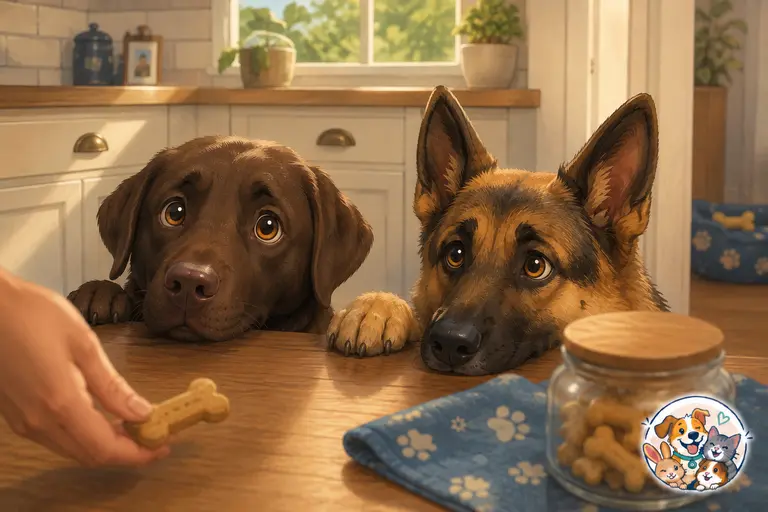
At home, we have two dogs: Largo, our German Shepherd, and Ulk, our chocolate Labrador.
Every morning, they get a small treat. The routine is well established: as soon as the first member of the family gets up, they come and sit nicely in front of them, waiting for their reward.
So far, nothing unusual.
But the funniest part is that a little later, when another person in the house gets up… they perform exactly the same routine again!
They sit down once more, put on their most innocent expression and wait as though they had received nothing yet.
And we have to admit… sometimes their strategy works! They walk away with a second treat.
So, do our pets really know how to lie to us?
Can Animals Lie?
Not exactly.
Lying, in the human sense of the word, involves knowing that information is false and deliberately communicating it in order to deceive someone.
With animals, specialists tend to talk instead about learned behaviours or strategies.
In other words, they remember what works… and then do it again.
Dogs Are Excellent Observers
Dogs spend a great deal of their time observing us.
They quickly learn which behaviours help them obtain a reward.
Sitting in front of someone leads to a treat?
Then why not try exactly the same thing with another person a few minutes later?
They probably are not thinking: “I’m going to pretend I haven’t had one yet.”
However, they do know that by repeating the same behaviour, they sometimes have a chance of getting what they want.
They Also Know the Family’s Habits Very Well
Dogs quickly learn who is most likely to give in.
Some know exactly who to approach for a cuddle, a walk… or an extra treat.
At home, Largo and Ulk seem to have realised that it is always worth trying their luck with every member of the family.
After all… if it works half the time, why stop?
What About Cats?
Cats are also very good at taking advantage of our habits.
How many owners have wondered whether their cat was trying to get a second meal?
A cat may meow in front of its bowl even though it has just been fed, then go and ask another person in the house.
Again, this is probably not lying, but rather a behaviour that has worked in the past.
Do Our Pets Know How to Manipulate Us?
In a way… yes.
They learn which behaviours get our attention.
An intense stare.
A paw resting on our leg.
A small whine.
Or that famous perfectly seated position in front of the cupboard where the treats are kept.
If a behaviour helps them get what they want one day, there is a good chance they will try it again.
So… Lying or Intelligence?
Ultimately, our companions probably do not lie in the same way humans do.
However, they are excellent observers.
They remember our habits, understand what works and adapt their behaviour accordingly.
That is also part of their intelligence and their remarkable ability to live alongside us.
Now It’s Your Turn!
Has your companion ever tried to “outsmart” you?
A second treat?
A second meal because they asked another person in the house?
Or perhaps an extra walk thanks to that irresistible look?
Tell us your best story on our social media. We are sure Largo and Ulk are not the only ones who like to try their luck!
In Conclusion
Our pets probably do not lie in the way we understand the word.
However, they are extremely good at observing our habits and repeating behaviours that bring them a reward.
At home, Largo and Ulk continue to try every morning. They sit nicely in front of each person who gets up, wearing their most innocent expression…
And, we have to admit, they still sometimes manage to walk away with a second treat.
It just goes to show… sometimes they know us almost as well as we know them!