
Did You Know? Cats Whiskers Also Work Like a Natural GPS
Did You Know? Cats Whiskers Also Work Like a Natural GPS
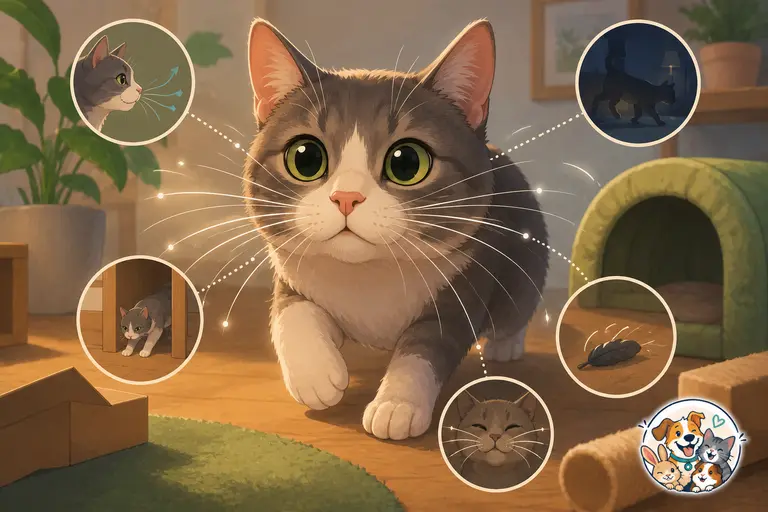
A cats whiskers are not simply there to give it a majestic or adorable appearance. These long hairs, known as vibrissae, are highly specialised sensory structures that play an essential role in everyday life.
They help cats move around, hunt, judge distances, and even communicate. This is why whiskers are often compared to a kind of natural GPS.
Whiskers Are Very Different from Ordinary Fur
Vibrissae are much thicker and stiffer than regular hairs.
Their most important feature lies beneath the skin: they are deeply rooted in follicles that contain a very high concentration of nerve endings.
At the slightest touch or even a small change in air movement, these receptors immediately send information to the brain.
This gives the cat a remarkably detailed sensory picture of its surroundings.
They Help Measure Narrow Spaces
You may have seen your cat pause for a few seconds before moving through a narrow gap.
This is not necessarily hesitation.
A cats whiskers often extend to roughly the width of its body.
By moving its whiskers forward, the cat can assess whether an opening is wide enough to pass through comfortably without getting stuck.
It is a kind of built-in measuring system.
They Help Cats Move in Low Light
Cats see very well in low-light conditions, but they cannot see in complete darkness.
In these situations, their whiskers become particularly useful.
They detect nearby obstacles, subtle air movements, and changes in the surrounding space.
Thanks to this information, cats can move with remarkable precision even when visibility is limited.
An Essential Tool for Hunting
Whiskers are also extremely useful when a cat is hunting.
When prey is very close to the cats muzzle, it can move outside its direct field of vision.
The whiskers then take over.
They help the cat detect the precise position of the prey and adjust its movements with great accuracy.
Even cats that live exclusively indoors retain this instinctive ability.
Whiskers Can Also Reveal a Cats Mood
Vibrissae are not used only for orientation.
Their position can also provide clues about a cats emotional state.
You can often observe that:
relaxed whiskers usually indicate a calm cat;
whiskers pointing forward can suggest curiosity or excitement;
whiskers pulled back against the face may indicate fear, stress, or discomfort.
By paying attention to their position, you can often better understand how your companion is feeling.
Can You Cut a Cats Whiskers?
No.
Whiskers are made of keratin, just like ordinary hair, so cutting the hair itself is not painful.
However, trimming them deprives the cat of one of its most important sensory tools.
The cat may become more hesitant, lose some spatial awareness, or have greater difficulty moving accurately through its environment.
Whiskers naturally fall out from time to time and grow back on their own.
They should therefore never be deliberately cut.
Why Do Cats Touch Objects with Their Whiskers?
You may have noticed your cat slowly bringing its face close to furniture, a cardboard box, or a new object.
It is doing more than simply looking.
Its whiskers help analyse:
distance;
the width of an opening;
the surface and position of nearby objects;
air movements around the face.
All of this information complements what the cat can see with its eyes.
In Conclusion
A cats whiskers are much more than an attractive physical feature.
They form a sophisticated sensory system that helps cats judge spaces, move more accurately, hunt efficiently, and even communicate their emotions.
The next time your cat explores your home, take a closer look at its whiskers: they are constantly gathering information to help it move safely through its environment.