
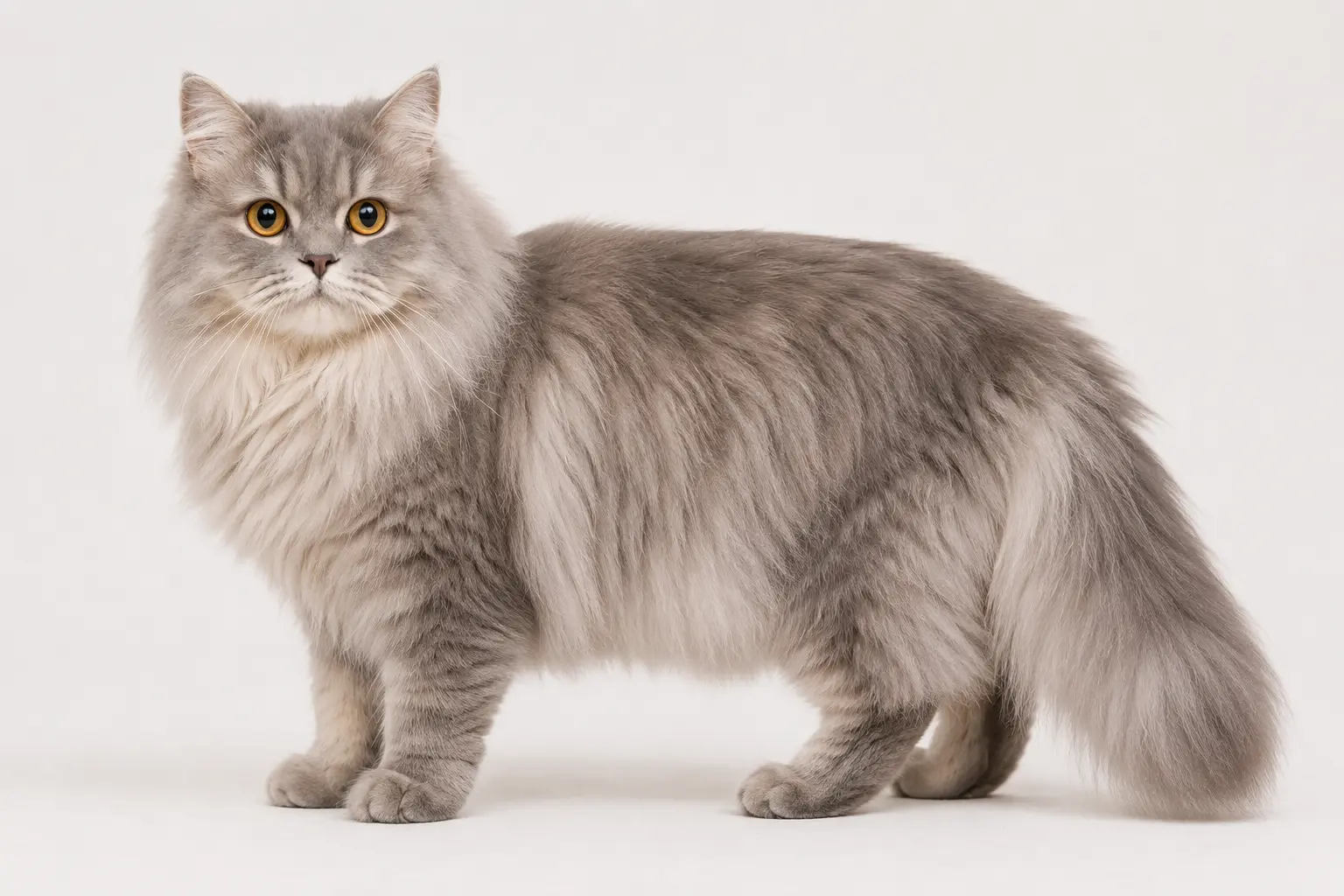




Everything you need to know about the British Longhair
With its powerful build, round head and particularly full coat, the British Longhair shares many characteristics with the British Shorthair while carrying a longer coat. Its teddy-bear appearance should not overshadow its needs: regular grooming, suitable nutrition, daily activity and an enriching environment all contribute to its well-being throughout life.
British Longhair and British Shorthair
The British Longhair is closely related to the British Shorthair. The historical introduction of longhaired cats into British breeding lines allowed the longhair trait to be passed down through generations.
The British Longhair therefore retains the characteristic British build: a compact, powerful cat with a broad chest, round head and gentle expression.
The most visible difference is naturally the length and volume of the coat, which gives the British Longhair an even fuller appearance.
A calm but engaged companion
The British Longhair is generally appreciated for its relaxed temperament. It may seek proximity to its owners without necessarily wanting to be carried or constantly sitting on their laps.
This relative independence does not mean it wants to live without interaction. It may enjoy following household activities, staying close to its people and participating in play sessions.
Every cat nevertheless has its own personality. Genetics, early socialization, previous experiences and environment also influence adult behavior.
A dense coat that requires regular care
The coat is one of the British Longhair’s defining characteristics. Dense and voluminous, it emphasizes the breed’s rounded, powerful appearance.
Regular combing removes loose hair before it accumulates and helps identify areas where tangles are beginning to develop.
Areas subject to friction and particularly full sections of coat deserve regular attention. The aim is to maintain the coat progressively rather than waiting for significant matting to develop.
Getting a kitten used to grooming
Grooming becomes much easier when a kitten is gradually introduced to combing, paw handling, ear checks and other routine care from a young age.
Early sessions can be short and associated with a calm, positive experience. There is no need to prolong a session once the kitten becomes impatient.
This familiarization makes regular care easier later and can also make examining the cat simpler when necessary.
Play, activity and environment
Although the British Longhair is generally less demonstrative in its activity than some highly energetic breeds, daily play remains important.
Short sessions with moving toys, balls, tracks, chase toys or searching activities help stimulate natural behavior.
Stable scratching posts, resting areas, hiding places and observation points complete its environment and allow it to alternate between activity and quiet time.
Monitoring weight beyond the number on the scale
The British Longhair naturally has a solid build, and its abundant coat can visually increase its apparent size. Body condition can therefore be difficult to assess simply by looking at the cat.
A diet suited to age, activity and body condition, combined with regular opportunities to play and move, helps maintain an appropriate balance.
Ideal weight varies with sex, build and individual characteristics. A veterinarian can help assess body condition and adjust nutrition when necessary.
Health: ask about the breeding cats
When choosing a breeder, ask which health-monitoring measures are used for the breeding cats and what health information can be provided.
Hypertrophic cardiomyopathy, commonly abbreviated HCM, is among the cardiac conditions that British breeders may monitor. Ask the breeder which examinations are performed within their lines and how often.
No screening program can guarantee that a cat will never develop a health problem. Family history, examinations performed and ongoing veterinary care nevertheless provide useful information before acquisition.
Kitten socialization
A kitten’s early experiences influence how it approaches people, handling and new situations. The environment provided by the breeder therefore deserves as much attention as the kitten’s appearance.
Ask how kittens are introduced to human interaction, ordinary household sounds, routine care and the different situations they may encounter after leaving.
A kitten’s behavior is not entirely predetermined by breed. Individual temperament and experience also play important roles.
Questions to ask the breeder
Ask about the kitten’s parents, their temperament, health history and the health examinations performed within the line.
Also ask about the kitten’s diet, routines, grooming, current environment and how it has been socialized.
A transparent discussion should help you understand the kitten’s needs and prepare for its arrival without abrupt changes in food, litter or routine.
Preparing for a British Longhair kitten
Before arrival, prepare a quiet area with water, food, litter, bedding, a scratching surface and a few hiding places. This allows the kitten to discover its new environment gradually.
Initially keep the diet and routines it was accustomed to whenever possible. Changes can then be introduced progressively.
Also prepare suitable grooming equipment so that short combing sessions can quickly become part of the kitten’s new routine.
Find a British Longhair breeder
Prousty & Co allows you to search for British Longhair breeders using the country, region, city and postal-code filters available on this page.
Browse profiles, compare the information provided and contact professionals directly to discuss their lines, breeding cats, socialization practices and the living conditions of their kittens before making your choice.