




Everything you need to know about the British Shorthair
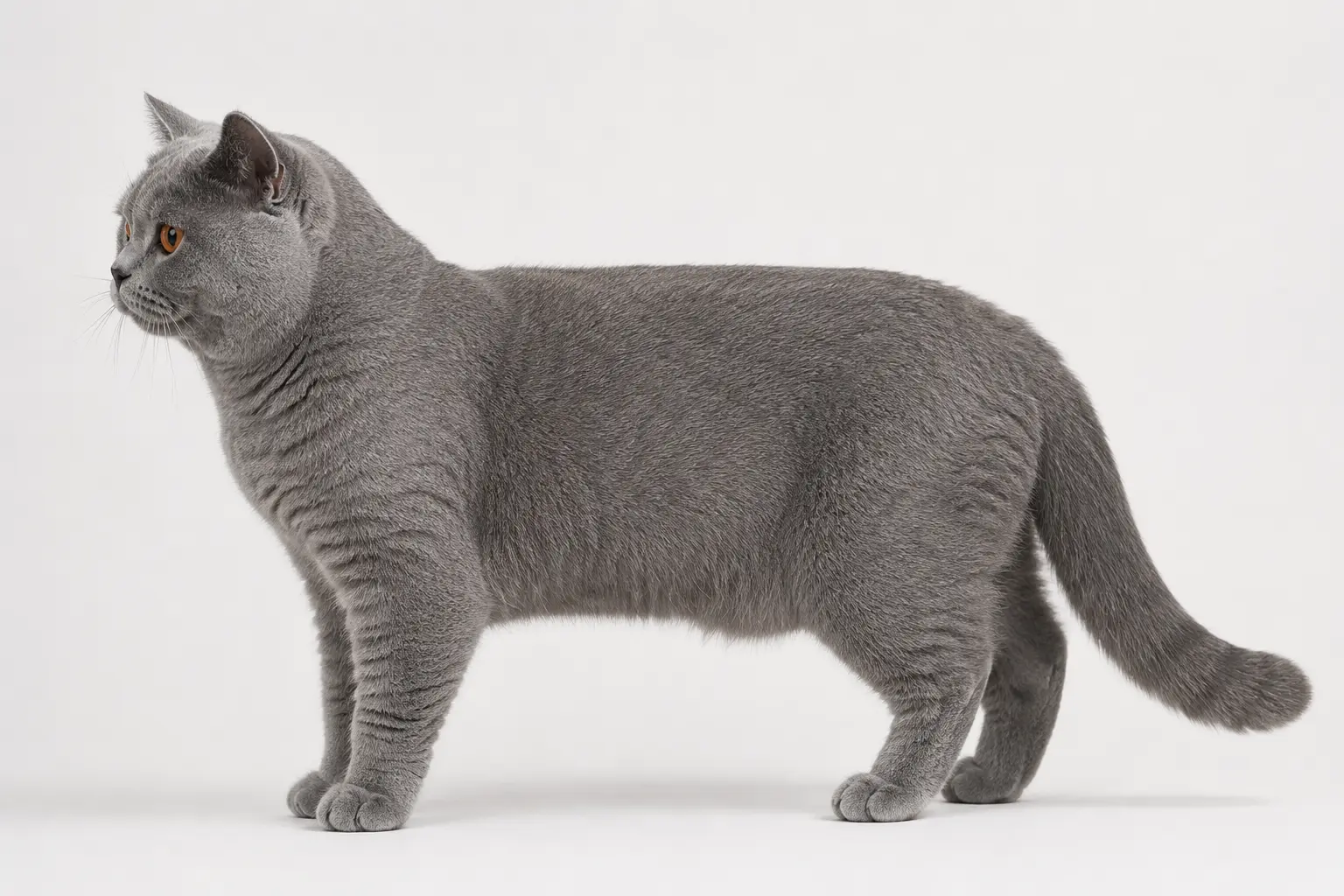
With its round head, full cheeks, sturdy build and short plush-looking coat, the British Shorthair has an immediately recognizable appearance. Behind its generally calm temperament is a cat that still needs interaction, activity, an enriching environment and nutrition suited to its build and lifestyle.
A powerful, rounded build
The British Shorthair is a solidly built cat. Its body is compact, muscular and broad, with a full chest and sturdy limbs.
Its round head, full cheeks and large eyes contribute to the breed’s characteristic expression. The dense coat further emphasizes its substantial appearance.
This naturally powerful build should be distinguished from excess body fat. A British Shorthair can be solid and muscular while maintaining an appropriate body condition.
The famous plush coat
The British Shorthair coat is short but exceptionally dense. It should not be confused with a fine short coat lying flat against the body: its density contributes directly to the breed’s rounded appearance.
The coat is often described as firm and plush. It occurs in many colors and patterns, although the blue British remains perhaps the best-known image of the breed.
Density and texture may vary with the season. Regularly observing the coat also helps identify unusual changes in its condition.
Blue, but not only
The blue-grey coat is iconic for the British Shorthair, to the point that the breed is sometimes automatically associated with this single color.
British Shorthairs nevertheless occur in many other colors and combinations. Coat color alone therefore does not define the breed.
When choosing a kitten, build, temperament, the health of the breeding cats and the conditions in which kittens are raised deserve more attention than an aesthetic preference for a particular color.
A calm and relatively independent companion
The British Shorthair is generally described as affectionate without being particularly demanding. Many prefer staying close to their family rather than constantly seeking to be carried or sitting on laps.
This relative independence can suit different lifestyles, but it should not lead to neglecting daily interaction.
As with all cats, temperament varies between individuals. Socialization, previous experiences and environment also strongly influence adult behavior.
Play and daily activity
An adult British Shorthair may appear very relaxed, but that does not mean it does not need to move. Daily play contributes to maintaining physical and mental activity.
Chase toys, wand toys, balls and activities that encourage searching can provide varied stimulation.
Several short sessions spread throughout the day may be more engaging than one long session, particularly for a naturally relaxed cat.
An environment suited to its build
An adult British Shorthair can be heavy and powerful. Cat trees, platforms and scratching posts should therefore be sufficiently stable to comfortably support its weight.
Accessible resting areas, hiding places and different observation points allow the cat to choose between resting, watching its environment and interacting.
A large stable scratching post also provides an opportunity to stretch and express natural scratching behavior.
Nutrition and body condition
The British Shorthair’s naturally substantial build can make weight assessment more difficult. Its dense coat can also visually increase its apparent volume.
Food quantity should be adapted to age, activity level, physiological status and individual body condition rather than using the same theoretical amount for every cat.
Regular monitoring of weight and body condition, combined with daily activity, makes it possible to adjust nutrition progressively when necessary.
Relatively simple grooming
Unlike the British Longhair, the British Shorthair does not have a coat that readily develops long tangles. Grooming is therefore relatively straightforward.
Regular combing nevertheless helps remove loose hair and can be particularly useful when the coat changes with the seasons.
These sessions also provide an opportunity to observe the skin, coat and general condition of the cat. Introducing the kitten to routine handling makes lifelong care easier.
Health: understand breeder screening
Before acquiring a kitten, ask what health information is available about its parents and line, as well as which examinations are performed on breeding cats.
Hypertrophic cardiomyopathy, or HCM, is among the cardiac conditions that can affect British Shorthairs. It is useful to ask the breeder how cardiac health is monitored within their lines.
Screening and family history provide useful information but can never guarantee an animal’s future health. Regular veterinary care remains important throughout life.
The importance of socialization
A British Shorthair’s personality does not depend on breed alone. A kitten’s early experiences also influence how it responds to people, handling and new situations.
Ask the breeder how kittens are introduced to human contact, ordinary household sounds, routine care and different aspects of their environment.
Gradual, respectful socialization helps kittens develop adaptability without forcing interactions they are not yet able to handle comfortably.
Questions to ask the breeder
Ask about the kitten’s age, current diet, routines, temperament and the conditions in which it is being raised.
Ask about its parents, their temperament, health history and the health examinations performed within the line.
A transparent discussion should also help you understand how the kitten has been socialized and the breeder’s recommendations regarding nutrition, grooming and adaptation to the new home.
Preparing for the kitten’s arrival
Before arrival, prepare a quiet space with water, food, litter, bedding, a scratching surface and a few hiding places. The kitten can then gradually discover the rest of the home.
Temporarily keeping the food and type of litter it already knows can reduce the number of simultaneous changes during the first few days.
Allow it to settle at its own pace. Play and interaction can then be developed progressively as the kitten becomes comfortable in its new environment.
Find a British Shorthair breeder
Prousty & Co allows you to search for British Shorthair breeders using the country, region, city and postal-code filters available on this page.
Browse profiles and contact professionals directly to discuss their breeding cats, lines, health monitoring, socialization practices and the living conditions of their kittens before making your choice.