


Everything you need to know about the Maine Coon
The Maine Coon is impressive in size, but size is only part of its identity. This slow-maturing breed has a long, sturdy build, a coat adapted to demanding weather conditions and a generally sociable, curious temperament. Welcoming a Maine Coon means planning for its adult dimensions, coat care, activity and health monitoring.
A large, slow-maturing cat
The Maine Coon is among the largest domestic cat breeds. Adult males are generally heavier than females, with considerable variation possible between individuals.
Maturation is relatively slow. A young Maine Coon may continue developing muscle, width and overall appearance for several years before reaching full maturity.
This gradual development means there is no reason to pursue an artificially high body weight. Sound construction and appropriate body condition matter more than an impressive number on the scale.
A naturally rugged build
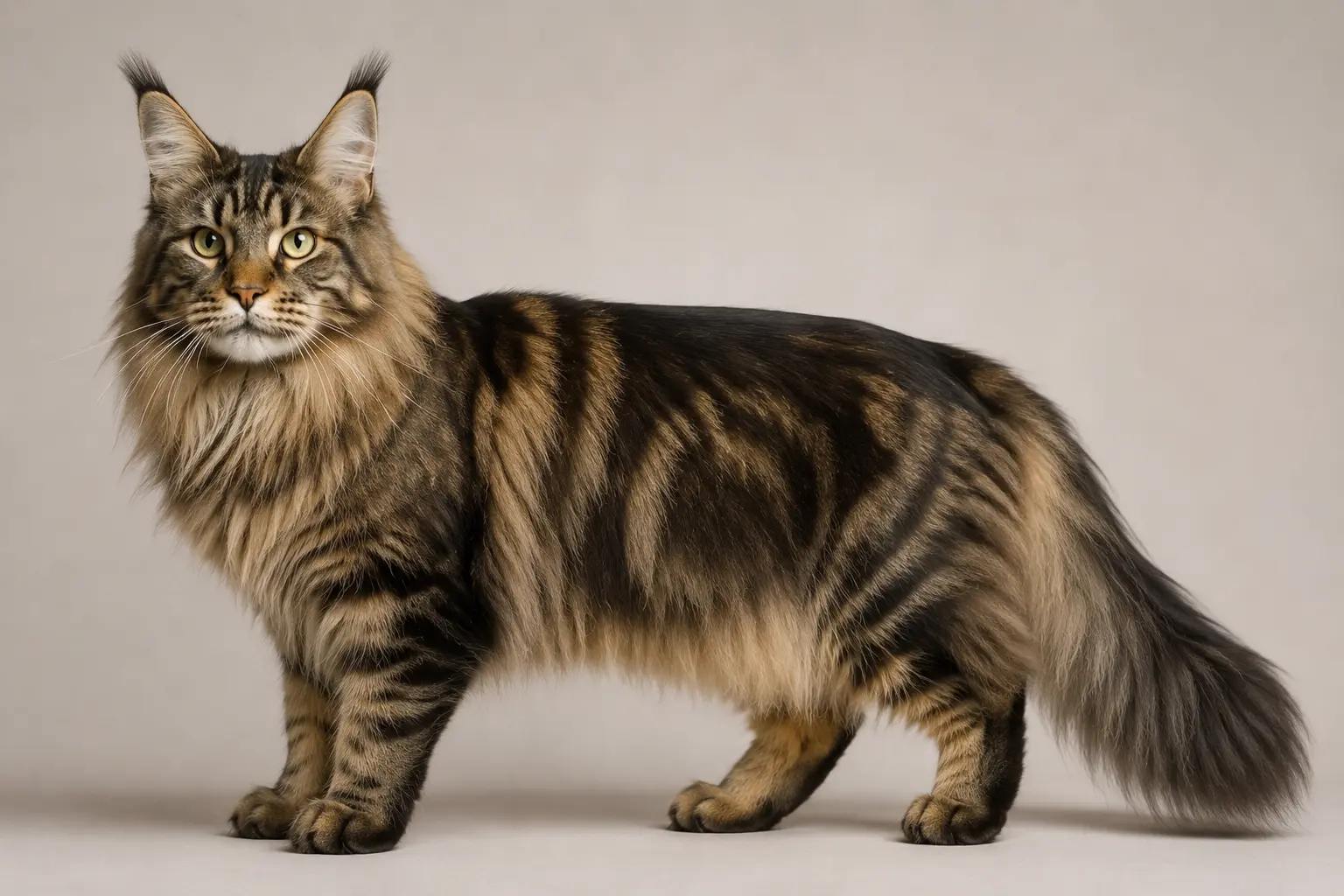
The Maine Coon has a long, muscular and well-proportioned body with a broad chest. Its overall outline is more rectangular than compact.
Its head notably features a defined muzzle, while large ears, substantial legs and a long full tail contribute to its characteristic appearance.
The breed standard emphasizes overall balance. Size alone should therefore never be considered the defining measure of a Maine Coon.
A coat that varies across the body
The Maine Coon has a semi-long coat that is not uniform across the entire body. It is generally shorter over the shoulders and fuller on the belly, hind legs and tail.
The long, full tail is one of the breed’s most distinctive visual features. A noticeable ruff may also develop in some adults.
Coat texture and density can vary between individuals and throughout the year. Some Maine Coons therefore require more grooming than others.
Introducing grooming from kittenhood
Regular grooming helps remove loose hair and prevent tangles. Areas where the coat is particularly full may require more frequent attention.
Gradually introducing a kitten to combing makes adult grooming considerably easier. Early sessions can remain short and be associated with a calm, positive experience.
Grooming also provides an opportunity to observe the skin, coat and general condition of the cat and notice unusual changes early.
Sociable without necessarily being dependent
The Maine Coon is generally described as people-oriented and interested in what is happening around it. Many enjoy following their family through the home and observing everyday activities.
This closeness does not mean every Maine Coon will constantly seek to be carried or sit on a lap. Some simply prefer staying nearby.
Temperament naturally varies between individuals. Early socialization, experiences and environment also have an important influence on adult behavior.
Play, exploration and stimulation
The Maine Coon often retains a playful nature into adulthood. Chase toys, searching activities and regular interaction can stimulate both body and mind.
Play sessions can be spread throughout the day and adapted to the cat’s age, temperament and physical condition.
A varied environment with several resting, observation, scratching and exploration areas also allows the cat to choose activities throughout the day.
Choose equipment suited to its size
The adult size of a Maine Coon should be considered when arranging the home. A cat tree designed for a much lighter cat may lack stability or provide platforms that are too small.
Choose sturdy structures, sufficiently large beds, tall stable scratching posts and a carrier suited to the cat’s dimensions.
The litter box deserves the same attention: a sufficiently spacious tray allows the adult cat to turn around and use it comfortably.
Nutrition and weight
The Maine Coon’s large size does not mean it should be fed to reach the highest possible body weight. The goal is to maintain an appropriate body condition for each individual.
Nutritional needs change with age, activity, growth, neutering status and body condition. Portions should therefore be adjusted individually.
Regular monitoring of weight and body condition helps identify gradual changes and allows nutrition to be adjusted with veterinary guidance when necessary.
Cardiac health: ask about HCM
Hypertrophic cardiomyopathy, commonly abbreviated HCM, is among the health conditions monitored in Maine Coon breeding lines.
When choosing a breeder, ask which examinations are performed on breeding cats and how cardiac health is monitored over time. Genetic testing can provide useful information but does not by itself replace broader cardiac monitoring.
No screening result can guarantee that a cat will never develop disease. The aim is to obtain the most transparent information possible about the health of the breeding cats and their line.
SMA, joints and other health information
Spinal muscular atrophy, or SMA, is a genetic condition for which testing can be used in Maine Coon breeding programs.
Because of the breed’s large build, joint health may also be among the areas monitored by breeders, particularly the hips.
Ask the breeder directly which examinations are performed within their lines and why. Available results, family history and veterinary monitoring provide more useful information than simply being told that the parents are “tested.”
Kitten socialization
A Maine Coon’s future temperament does not depend on breed alone. A kitten’s early experiences also influence how it responds to people, handling and new situations.
Ask how kittens are introduced to human interaction, ordinary household sounds, grooming, transport and different aspects of their environment.
Gradual and respectful socialization helps kittens develop adaptability while respecting their individual personalities.
Questions to ask the breeder
Ask about the kitten’s parents, their age, temperament, health history and the health examinations performed.
Ask about the kitten’s growth, current diet, grooming routine, socialization and habits it has already developed.
A transparent discussion should help you understand the breeder’s choices and obtain specific answers rather than general claims about the size, health or temperament of their cats.
Preparing for a Maine Coon kitten
Before arrival, prepare a quiet area with water, food, litter, bedding, a scratching surface and hiding places. The kitten can then gradually explore the rest of the home.
Plan for its future size from the beginning. Some equipment suitable for a small kitten may quickly become too narrow or insufficiently stable.
Temporarily maintaining its familiar food and routines can make the transition easier. Changes can then be introduced progressively.
Find a Maine Coon breeder
Prousty & Co allows you to search for Maine Coon breeders using the country, region, city and postal-code filters available on this page.
Browse profiles and contact professionals directly to discuss their breeding cats, lines, health examinations, socialization practices and the living conditions of their kittens before making your choice.