
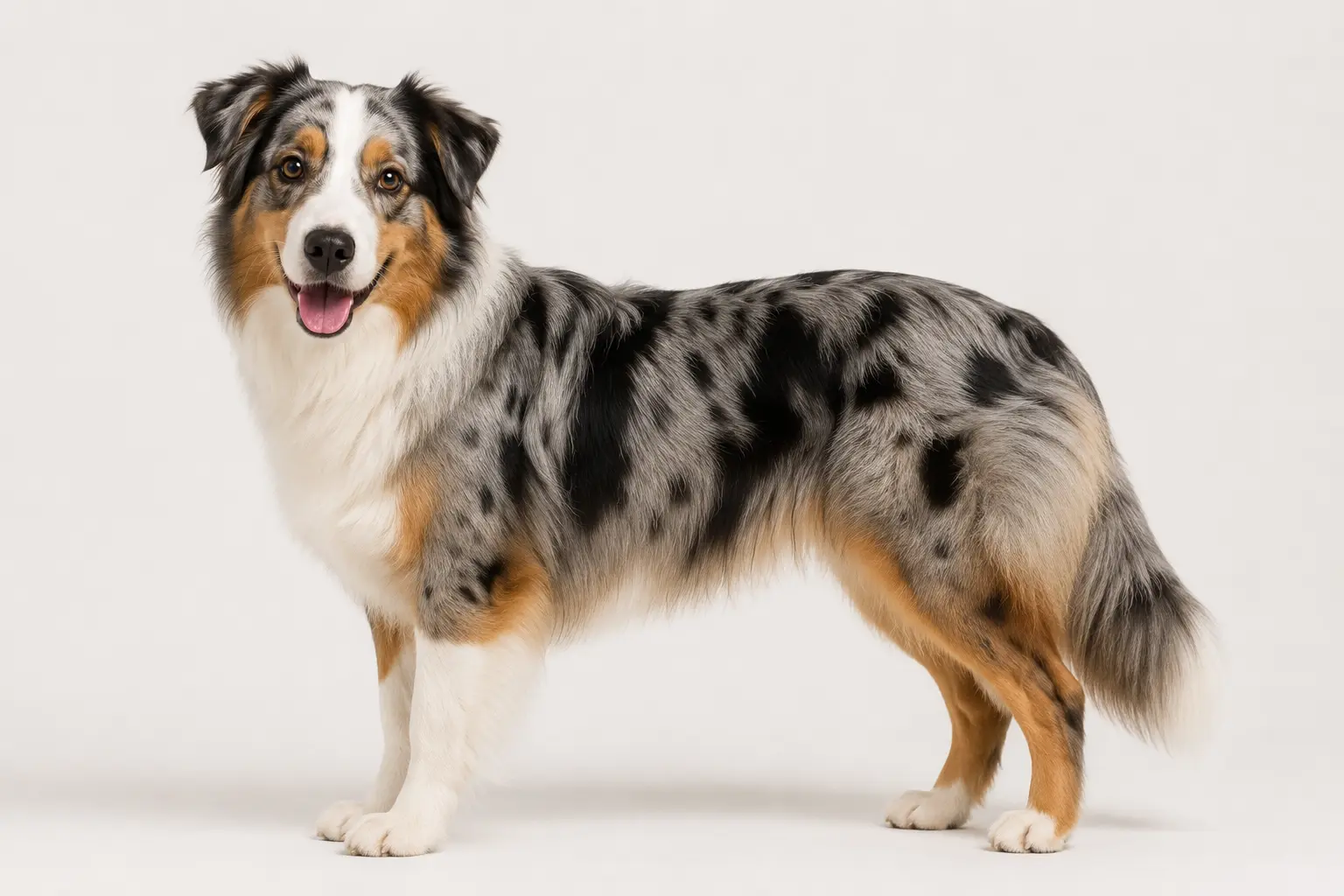




Everything you need to know about the Australian Shepherd
The Australian Shepherd is a herding dog developed to work in cooperation with people. Intelligent, observant and generally highly responsive to learning, it can enthusiastically engage in many activities. In return, this willingness benefits from a structured daily routine combining outings, exploration, mental stimulation, learning to settle and genuine periods of rest.
An Australian Shepherd developed in the United States
Despite its name, the Australian Shepherd as we know it today was developed in the United States. Its name is historically associated with Basque shepherds who came to the United States from Australia during the nineteenth century.
The breed notably developed on American farms and ranches, where its versatility, intelligence and herding abilities were valued.
This working-dog history helps explain characteristics still found today: attentiveness to the environment, learning ability, stamina and an interest in activities performed with people.
A dog attentive to its surroundings
The Australian Shepherd is generally attentive, responsive and highly involved in what happens around it. Its herding instinct can notably increase its interest in movement and changes in the environment.
This attentiveness is a valuable asset for learning, but it also needs guidance. The dog should progressively learn that it does not need to react to or become involved in every movement, person or event.
Temperament naturally varies between individuals. Genetics, early experiences, socialization, learning and environment all contribute to behavioural development.
Socializing without overwhelming the puppy
Australian Shepherd socialization can begin with progressive exposure to people, suitable dogs, vehicles, urban or rural environments, surfaces, sounds and everyday situations.
Simply increasing the number of stimuli is not an objective in itself. A positive, controlled experience is generally more valuable than a succession of overwhelming situations.
Observing the puppy’s body language, allowing it to create distance and regularly providing periods of rest can help build calmer experiences.
Channeling its desire to learn
The Australian Shepherd often learns quickly and may anticipate household routines. This ability makes training particularly rewarding, provided expectations remain understandable and consistent.
Recall, leash walking, waiting, disengagement, handling and settling are useful everyday skills.
Short, progressive sessions help develop concentration without turning every moment of the day into an exercise. Independence and the ability to relax are just as important as learning new behaviours.
Activity does not replace learning to settle
With an active dog, it can be tempting to continually add activities in an attempt to tire it out. However, constantly increasing the intensity of outings and games is not enough to build a balanced daily routine.
The Australian Shepherd can also learn to wait, observe without becoming involved, remain quietly in its resting area and recover after activity.
Alternating exploration, learning, physical activity and genuinely quiet periods creates a more varied and predictable rhythm.
Varied activities rather than physical exercise alone
Exploratory walks, search games, scent activities, learning new behaviours and suitable sporting activities can provide an Australian Shepherd with different forms of engagement.
Activities involving problem solving or scent notably allow the dog to be stimulated in ways other than running or highly dynamic games.
Duration and intensity should be adapted to each dog’s age, physical condition and health. If in doubt, particularly with a growing puppy or a dog with a health concern, seek veterinary advice.
Coat, colours and grooming
The Australian Shepherd has a medium-length coat that may be straight or slightly wavy. Colours include black, red, blue merle and red merle, with different combinations of markings.
Regular brushing helps remove loose hair, limit tangles and provides an opportunity to monitor the skin. Shedding periods may require more frequent grooming.
Ears, nails and teeth also deserve regular attention as part of routine care.
Health: ask for screening results
Before choosing an Australian Shepherd puppy, ask which health examinations are performed on the breeding dogs and whether the results can be reviewed. Exact recommendations can vary depending on country, bloodline and reference organization.
Hips, elbows and eyes are among the areas that may be monitored in the breed. Genetic tests also exist for certain inherited mutations or conditions found in Australian Shepherds, including MDR1-related drug sensitivity.
A screening result can never guarantee a puppy’s future health. It nevertheless provides useful information for understanding the breeder’s selection process.
Choosing an Australian Shepherd suited to your lifestyle
The Australian Shepherd does not require an identical sporting programme in every household. It does, however, generally benefit from regular interaction, opportunities to explore and an environment where it can use its learning abilities.
Before adoption, describe your daily life accurately to the breeder: environment, available time, children or other animals in the household, previous dog experience and planned activities.
This discussion can help identify a puppy whose temperament and activity level are better suited to the household rather than choosing primarily according to coat colour or markings.
Preparing for the first weeks
Before the puppy arrives, prepare a quiet resting area and secure the spaces it will be able to access. Also provide the equipment needed for meals, outings, transport and initial activities.
The first few days can remain relatively simple. The puppy is already discovering a new home, new people, new smells and new routines.
Toilet training, sleep, handling, recall, leash walking, progressive environmental exposure and short periods alone can then be introduced gradually while respecting the puppy’s need for rest.
Questions to ask the breeder
Ask about the parents’ temperament, health, activities and living conditions. Find out which health screenings have been performed and whether the results are available.
Also ask about the puppies’ first weeks: environment, handling, encounters, outings, everyday sounds and the methods used to progressively introduce new situations.
Finally, ask how puppies are matched with future households and what support is offered after they leave.
Find an Australian Shepherd breeder
Prousty & Co allows you to search for professionals offering Australian Shepherds using the country, region, city and postal-code filters available on this page.
Browse professional profiles, compare the information provided and contact them directly to discuss their dogs, breeding practices, health screening and the conditions for welcoming a future puppy.