


Everything you need to know about the German Shepherd
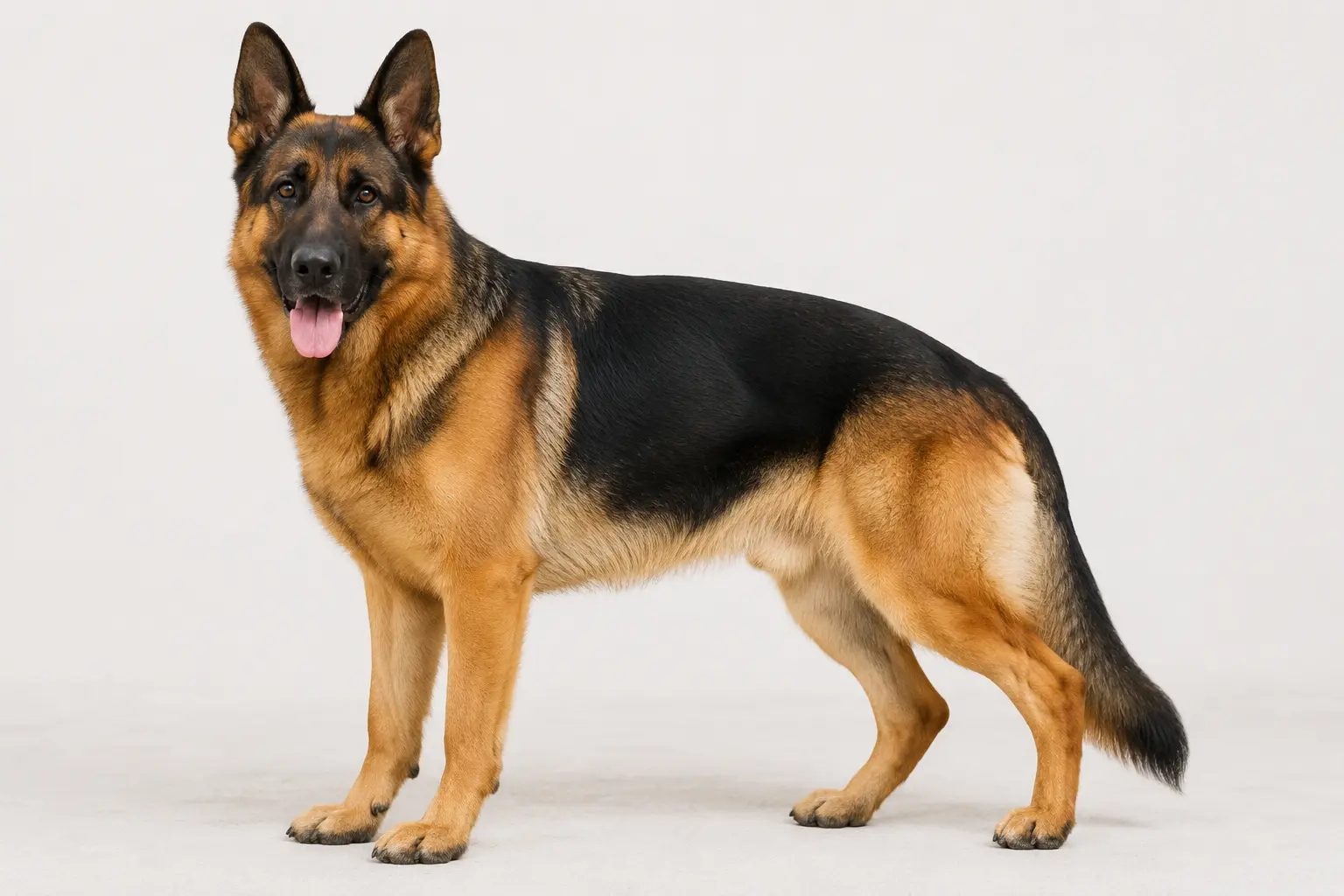
The German Shepherd was originally developed as a working breed, with selection focused on both physical ability and behavioural qualities. Today it may live as a family, sport or working dog depending on the individual, while generally retaining a strong interest in learning and cooperation. A balanced daily life therefore involves not only physical exercise but also interaction, training and mental stimulation.
A shepherd dog that became highly versatile
The systematic development of the German Shepherd began at the end of the nineteenth century using herding dogs found in different regions of Germany. Selection notably aimed to produce a capable, functional working dog willing to cooperate.
This history helps explain why the breed remains associated with many different activities. Beyond physical ability, its capacity to learn, remain attentive to its handler and work in varied situations is an important part of its identity.
Attentiveness, confidence and willingness to cooperate
The breed standard notably seeks a well-balanced, self-assured, attentive dog willing to cooperate. These qualities partly explain the German Shepherd’s versatility in different contexts.
This does not mean that every individual reacts in the same way. Genetics, early experiences, socialization, learning and environment all contribute to the development of each dog’s behaviour.
Building progressive socialization
Socialization does not mean exposing a puppy to as many encounters as possible. A puppy can progressively discover people, animals, environments, surfaces, sounds and different situations while maintaining enough distance and security to remain comfortable.
The goal is to create positive, controlled experiences. Observing the puppy’s behaviour and adjusting difficulty helps prevent a new experience from becoming overwhelming.
Training that engages intelligence
The German Shepherd generally learns quickly when it understands what is expected. Short, consistent, reward-based sessions can progressively develop useful everyday behaviours.
Recall, leash walking, waiting, settling, handling and maintaining focus around distractions are particularly useful skills.
Difficulty can then increase progressively. The goal is not to accumulate exercises but to build clear communication and reliable behaviour in different environments.
Scent work, searching and mental stimulation
Activities involving scent can be an interesting way to engage a German Shepherd. Searching for food, locating an object or progressively following a simple track can stimulate its abilities without relying solely on physical exercise.
Search games can easily be integrated into walks or practised at home. They provide variety and give the dog simple problems to solve.
Adapting physical activity to each stage of life
The German Shepherd generally enjoys active outings, but the amount and intensity of exercise should take age, physical condition and health into account.
For a growing puppy, the goal is not to reproduce an adult dog’s activities. Exploration, suitable walks, free play and short learning sessions can progressively build a balanced routine.
For an adult dog, activities can become more varied according to ability and preference. If there is any doubt about suitable exercise for a dog’s physical condition, a veterinarian can help establish appropriate limits.
Double coat or long double coat
The breed is recognized with two coat varieties: double coat and long double coat. In both cases, regular brushing helps remove loose hair and provides an opportunity to monitor the condition of the skin.
Shedding periods may require more frequent grooming. Ears, nails and teeth also deserve regular attention.
Health: look closely at the breeding dogs
Before choosing a puppy, ask which health examinations are performed on the breeding dogs and whether the results can be reviewed. Screening recommendations can vary between countries and reference organizations.
Hips and elbows are among the areas evaluated by several German Shepherd health programs. Other examinations may also be used depending on bloodlines and the recommendations followed by the breeder.
Screening can never guarantee a puppy’s future health. It does, however, provide useful information about the breeding dogs and the breeder’s selection process.
Choosing a dog suited to your lifestyle
Two German Shepherds can differ in activity level, motivation and temperament. Before adoption, clearly explain your environment, experience, planned activities and the daily life you can offer the dog.
Talking with the breeder helps you understand the characteristics of the parents and puppies. Choosing an individual compatible with your lifestyle is generally more relevant than choosing solely on appearance.
Preparing for your puppy
Before arrival, prepare a quiet resting area, secure accessible spaces and provide the equipment needed for meals, outings, transport and initial activities.
The first weeks allow habits to develop progressively: toilet training, sleep, handling, recall, leash walking, discovering new environments and learning to spend short periods alone.
The puppy also needs enough time to sleep and recover between new experiences. The quality of experiences matters more than simply accumulating them.
Questions to ask the breeder
Ask to meet or obtain information about the parents, their temperament, health and activities. Also ask about health examinations, the conditions in which the puppies are raised and the experiences they receive before leaving.
You can also ask how breeding pairs are selected, how puppy development is monitored and what advice or support is available after puppies join their new families.
Find a German Shepherd breeder
Prousty & Co allows you to search for professionals offering German Shepherds using the country, region, city and postal-code filters available on this page.
Browse professional profiles, compare the information they provide and contact them directly to discuss their dogs, breeding approach and the conditions for welcoming a future puppy.