



Everything you need to know about Koi Carp
Keeping Koi Carp is about more than choosing beautiful fish. Their growth, longevity and dependence on environmental quality mean the pond should be considered as a complete ecosystem: water volume, filtration, oxygenation, feeding, stocking density and preventive health management all need to work together.
Nishikigoi: Japanese ornamental carp
The Japanese term Nishikigoi refers to ornamental carp selectively bred for their colors and patterns. Their historical development is particularly associated with the Niigata region of Japan.
Starting from carp displaying color variations, generations of selective breeding gradually produced many different varieties. Some are distinguished by strongly contrasting colors, while others feature particular patterns, scales or metallic effects.
Modern Koi are therefore the result of a long history of selective breeding. Their appearance can continue to evolve as they grow, including changes in body development, color and pattern.
Kohaku, Sanke, Showa and many other varieties
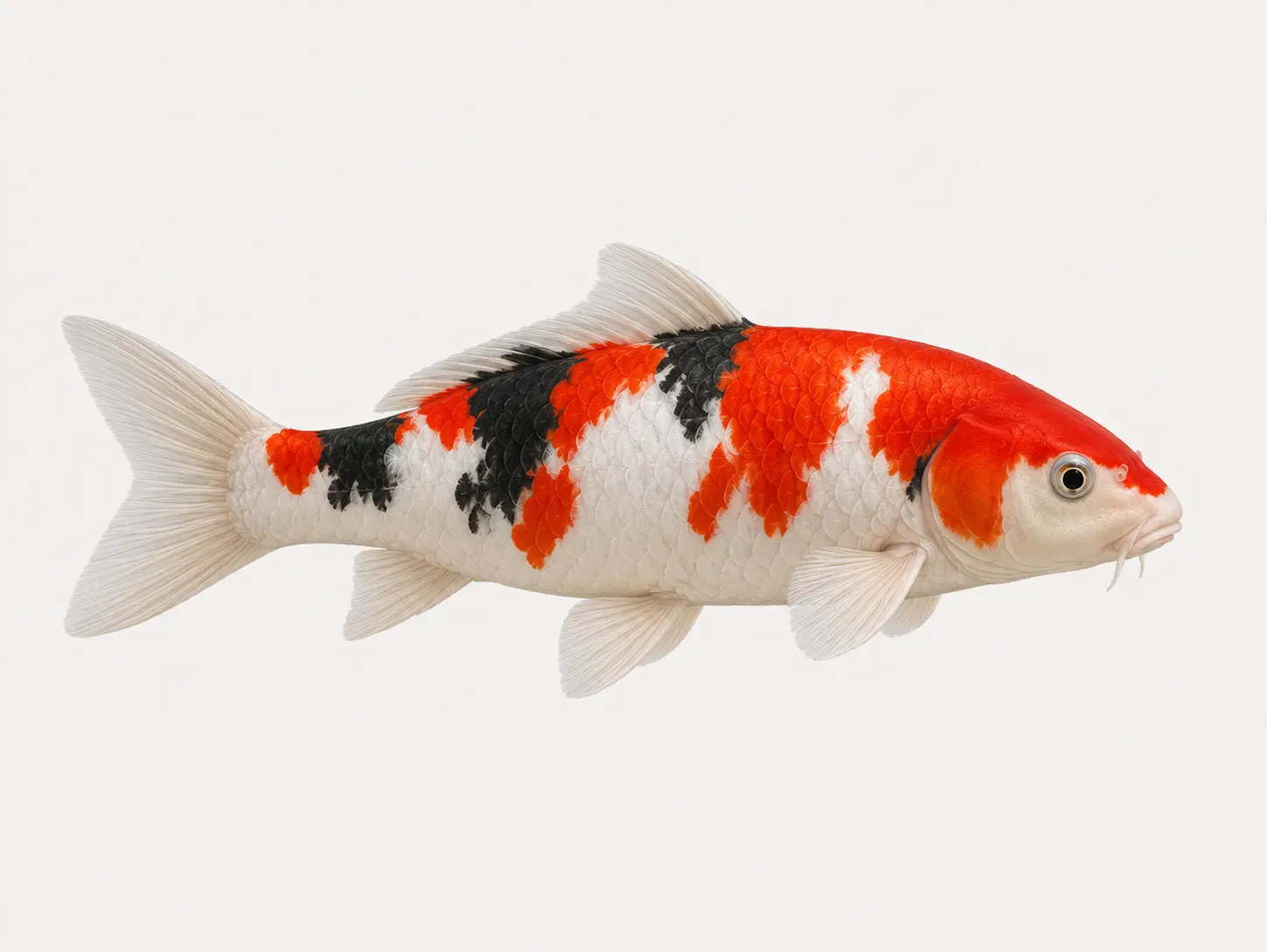
There are many Nishikigoi varieties. Kohaku, for example, combines a white base with red markings, while other varieties introduce black, metallic effects or different scale characteristics.
Japanese variety names describe groups of visual characteristics and make communication between breeders, enthusiasts and buyers easier.
A pond keeper does not need to master every classification. Correctly identifying the variety being offered is nevertheless useful for understanding its appearance and how it may develop.
Plan the pond for adult size
A small Koi can develop into a substantial fish. The pond should therefore be designed for the future dimensions of the fish rather than only their size at purchase.
Required volume depends on fish numbers, size, filtration, oxygenation, climate and overall pond management. A single rule expressed as liters per fish cannot replace an assessment of the complete system.
Providing sufficient capacity from the beginning is generally easier than having to completely rebuild a pond that becomes undersized a few years later.
Mechanical and biological filtration
Filtration plays a central role in a Koi pond. Mechanical filtration removes solid waste from the water, while biological filtration relies on microorganisms involved in processing nitrogenous waste.
A filter should be sized according to the pond’s actual biological load and maintained in a way that preserves efficiency without unnecessarily disrupting its biological component.
The pond and filtration system should be considered together. Adding more fish also increases the amount of waste the system needs to process.
Understanding the nitrogen cycle
Fish and organic matter produce waste that affects water quality. In a biologically established system, microorganisms are involved in processing compounds including ammonia and then nitrite.
A newly established pond or a disrupted biological filter may not immediately have enough capacity to process all the waste being produced.
Regular water testing avoids relying solely on appearance. Water that looks clear does not necessarily have parameters suitable for fish.
Oxygenation and temperature
Adequate oxygenation is important for the fish and for the biological functioning of the pond. Requirements can change according to temperature, fish density and system design.
Warm periods require particular attention because rising temperatures alter pond conditions and can reduce the amount of oxygen available in the water.
Air pumps, surface movement, waterfalls and other devices can contribute to oxygenation depending on pond design.
Feeding according to season and fish
Food formulated for Koi provides an appropriate nutritional basis. The amount offered should take account of fish size, activity, water temperature and the recommendations associated with the food being used.
Providing more food than the fish can consume does not necessarily improve growth and increases the amount of waste the pond must process.
Appetite can vary considerably with environmental conditions. Feeding practices should therefore be adjusted through the seasons rather than remaining identical throughout the year.
Observe the fish every day
Daily observation is one of the simplest ways to identify problems early. Appetite, swimming behavior, position within the pond and external appearance provide valuable information.
A Koi that suddenly isolates itself, stops eating, swims abnormally or develops visible changes to its skin or fins deserves particular attention.
If signs are persistent or significant, it is preferable to investigate the cause and seek advice from a professional experienced in fish health rather than using treatments at random.
Quarantine before introduction
Introducing a new fish is a significant change for an established population. A separate system allows new Koi to be observed before they enter the main pond.
This period provides an opportunity to monitor behavior, feeding and general condition without immediately mixing the new fish with the existing population.
Quarantine protocols should be adapted to the system and health context. For specific situations or when symptoms are present, advice from a professional experienced in fish health is preferable.
Transport and acclimation
Transport is a stressful period and should be organized according to fish size, journey duration and environmental conditions.
Before purchase, ask the professional how the Koi will be packed and what arrival instructions are recommended. Prepare the pond or quarantine system before the fish leaves the seller.
Acclimation should avoid abrupt changes in conditions. The appropriate method depends in particular on differences in temperature and water quality between the transport container and receiving system.
Questions to ask the breeder
Ask about the Koi’s variety, approximate age, current size, diet and the general conditions in which it is maintained.
Also ask about the origin of the fish, quarantine practices, health observations and any treatments it has received.
Finally, discuss transport conditions and recommendations for arrival. The more precise the information, the easier it is to prepare an appropriate transition from the breeder’s system to your own.
Preparing for a new Koi
Before purchase, make sure the system already has enough capacity for the additional fish. Consider its future size rather than only its current dimensions.
Check filtration, oxygenation and the main water parameters. A stable system is preferable to a pond that is hastily modified on the day the fish arrives.
If quarantine is planned, that system should also be prepared and functioning before the fish is transported.
Find a Koi Carp breeder
Prousty & Co allows you to search for breeders and professionals offering Koi Carp using the country, region, city and postal-code filters available on this page.
Browse profiles and contact professionals directly to discuss available varieties, fish origin, husbandry conditions, feeding, health practices and transport before making your choice.