
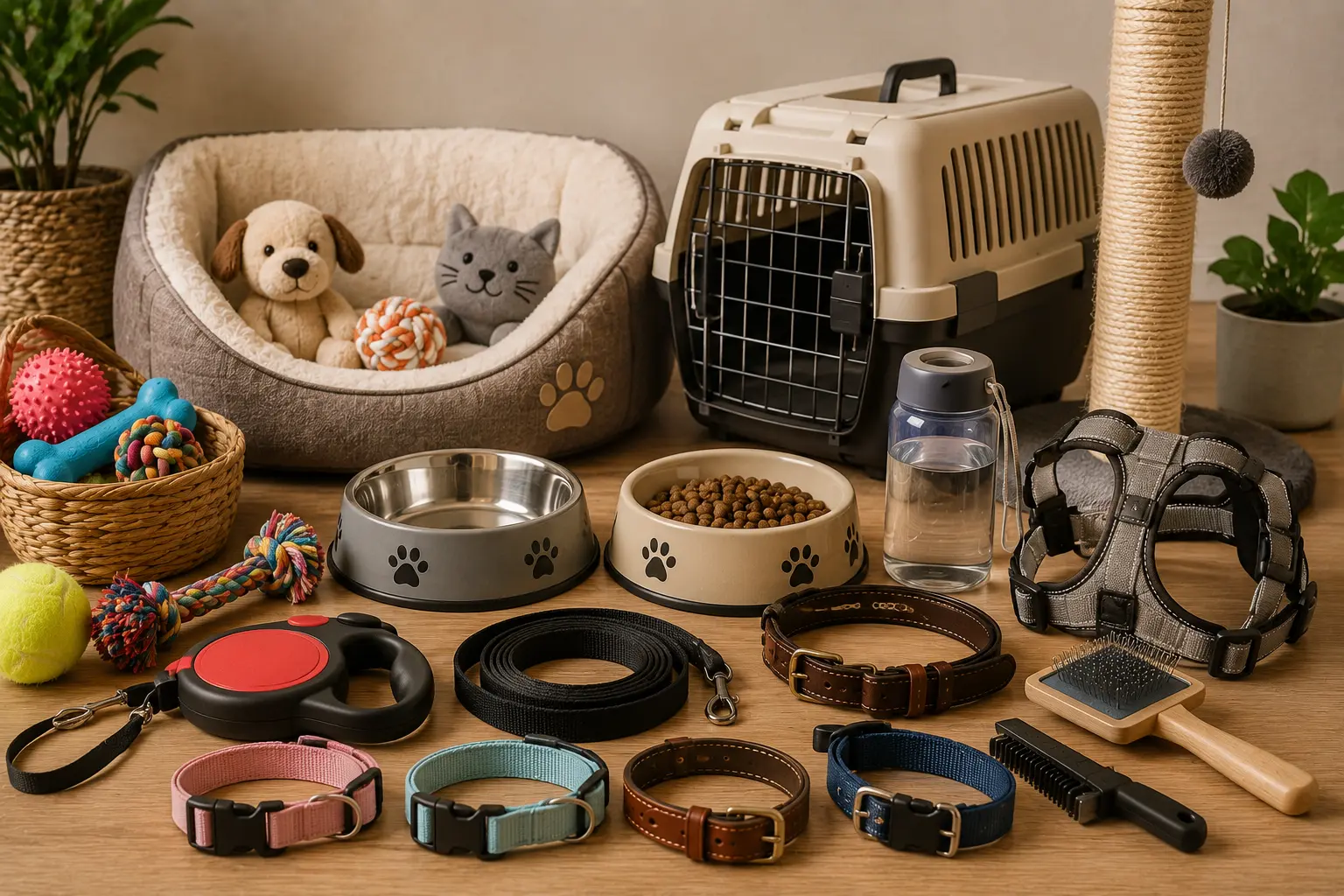
Choosing suitable accessories for your pet
Pet accessories are part of many aspects of everyday life, including travel, rest, feeding, walks, play, transport and environmental setup. The right choice depends on the species as well as each pet’s size, body shape, age, behavior and lifestyle. Prousty & Co allows you to search for stores offering pet accessories and equipment.
Which accessories should you choose for your pet?
The needs of dogs, cats, rabbits, rodents, birds, fish and reptiles are different. Before buying equipment, check that it is actually intended for the species concerned and suitable for its intended use.
Correct sizing is also important. An accessory that is too small, too large, too heavy or poorly fitted may be uncomfortable, ineffective or unsuitable for the pet.
Harnesses, collars and leashes
When choosing a harness or collar, measure the pet and check the manufacturer’s sizing information. Equipment should remain correctly positioned during use without unnecessarily restricting movement.
Leash choice depends on factors including the pet, its size and the context in which it will be used. Fasteners, stitching and attachment points should be checked regularly.
Check the fit regularly
Equipment that fits correctly today may no longer fit after growth, weight gain or loss, or changes in the coat. Regularly check the fit of harnesses, collars and other equipment worn by your pet.
Choosing a suitable bed
A bed should provide enough room for the pet to rest comfortably. Its shape, thickness and location can be selected according to the pet’s size, habits and preferences.
Also consider maintenance: a removable cover or easy-to-clean material can make it easier to keep the resting area clean.
Bowls and feeding accessories
The size and shape of feeding containers should suit the pet and the type of food provided. They should be easy to clean and sufficiently stable for their intended use.
Some pets may also use accessories designed to slow feeding or encourage food searching. Check that the device is appropriate for the species and does not create excessive difficulty.
Toys and enrichment
Toys can encourage activity, exploration, food searching and other species-appropriate behaviors. However, different pets may use the same objects in very different ways.
Choose toy size, materials and durability according to the pet and the way it plays. Monitor its condition and remove it when damage becomes significant enough to create a risk.
Vary activities rather than simply accumulating toys
The value of an accessory also depends on how it is used. Rotating some toys or offering different activities can renew a pet’s interest without constantly increasing the number of objects available.
Carriers, bags and transport accessories
Transport equipment should be selected according to the species, pet size, type of journey and expected duration. It should allow the pet to be transported appropriately while limiting the possibility of escape.
Check closures, ventilation, dimensions and construction. Requirements can differ considerably between a cat, small mammal, bird or reptile.
Accessories for rabbits and small mammals
For rabbits, guinea pigs, hamsters, rats and other small mammals, the environment should be equipped according to the behaviors and needs of the particular species.
Hiding places, tunnels, platforms, resting areas, food-search accessories and equipment supporting particular activities may be considered depending on the pet. Always check product dimensions and safety.
Accessories for birds
Bird accessories should take account of species, size, movement abilities and behavior. Perches, baths, toys and enrichment equipment are not universally suitable for every bird.
Check the size of items, materials used and how they are attached. The setup should preserve enough space for the bird to move around.
Aquarium equipment
For fish and other aquatic animals, equipment should be selected according to the species kept and the size of the setup. Filtration, heating, lighting, decoration and monitoring instruments serve different purposes.
Before purchasing equipment, check that it is appropriate for the relevant volume and the parameters required by the animals you keep.
Equipment for reptiles
Terrariums, heat sources, lighting, monitoring devices, hiding places and other equipment should be selected for the particular species. Requirements can vary considerably between different reptiles.
Avoid choosing equipment simply because it is labelled for reptiles. Check the specific requirements of the species and the technical characteristics of the product.
Check materials and construction
Examine stitching, attachments, closures, edges, small components and other parts that could become detached or worn. A product should remain suitable for the way your pet uses it.
An accessory that is durable for one pet may not be durable for another. Check its condition regularly and replace it when it can no longer be used appropriately.
Be careful with small and detachable parts
Some pets chew, scratch, tear or shake their accessories vigorously. Observe how your pet uses a new product so that potentially detachable components can be identified quickly.
If a toy or accessory becomes damaged enough to release pieces that could be swallowed or injure the pet, stop using it.
Cleaning and maintaining pet accessories
Bowls, beds, toys, carriers and other accessories may require regular maintenance. Before purchasing, check cleaning instructions and make sure they are compatible with the intended use.
A product that is difficult to clean may become impractical for everyday use even if it appears suitable when purchased.
Choose according to actual use
Before purchasing, consider where, when and how the accessory will be used. Equipment intended for occasional travel, everyday use, outdoor use or indoor use may have very different requirements.
Comparing dimensions, materials, weight, closure systems and maintenance requirements is often more useful than choosing solely on the product’s appearance.
Ask for advice in store
When looking for a particular accessory, specify the species, size, relevant measurements and intended use. For some equipment, bringing exact measurements of the pet or its setup can help avoid sizing mistakes.
Also ask about use and maintenance instructions and, where relevant, exchange options if the selected size does not fit.
An accessory does not replace professional advice
When equipment is being considered because of a health problem, pain, mobility difficulty or behavioral concern, seek advice from an appropriate professional rather than relying solely on purchasing a product.
A veterinarian can advise on health-related needs, while an appropriate behavior or training professional may help when the difficulty concerns equipment use in a behavioral context.
Check requirements applicable to products
Requirements applying to the manufacture, labeling, sale or use of certain products may vary by country, territory and equipment type. Check the information supplied with the product and applicable requirements in your area when necessary.
Find a pet accessories store on Prousty & Co
Prousty & Co allows you to search for stores and professionals offering pet accessories and equipment.
Review profiles to identify professionals matching your search, then contact them to ask about available products, supported species and advice before visiting.