
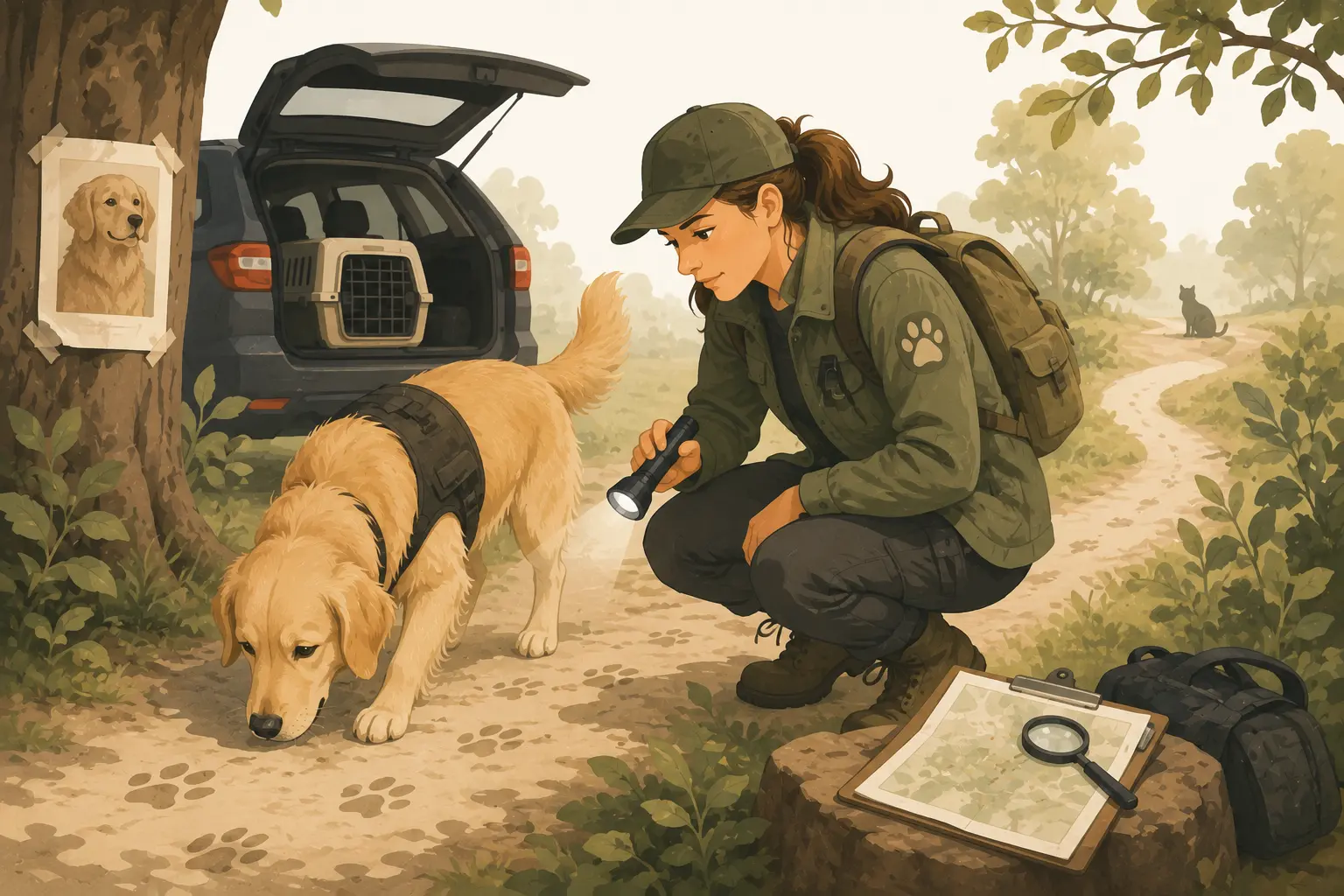
Using a pet detective to search for a lost pet
When a pet goes missing, it is often important to act quickly while organizing the search methodically. A pet detective or lost-pet search professional can help the owner analyze the circumstances, assess sightings, organize field searches and coordinate different actions. Methods may vary according to species, behavior, location and circumstances. Prousty & Co allows you to search for professionals offering this type of assistance.
What does a pet detective do?
The term pet detective can describe professionals who provide specialized assistance in searching for missing pets. Depending on the professional and the situation, services may include analyzing the disappearance, organizing searches, assessing sightings, field work or advising the owner.
Services are not necessarily identical from one professional to another. Before hiring someone, ask exactly which methods are offered and what is included in the service.
Start searching quickly
As soon as the pet is noticed missing, carefully check the home, garden and immediate surroundings. Some animals may be hiding, accidentally trapped or remain very close to where they were last seen.
Also speak with anyone present when the pet disappeared to establish the approximate time, last known location and circumstances that may explain how the pet escaped or left.
Reconstruct the circumstances of the disappearance
A search often begins by collecting precise information: where and when the pet was last seen, possible direction of travel, available exits, the pet’s habits and any unusual events occurring at the same time.
An open door, gate, sudden noise, unfamiliar location, escape during transport or recent environmental change may influence how the search is organized.
Adapt the search to the pet
There is no single search method suitable for every missing pet. Species, temperament, age, health, habits and familiarity with the location can all influence behavior after disappearance.
A social pet may approach people, while a very fearful animal may avoid humans, remain silent or hide. These differences should be taken into account in the search strategy.
Searching for a lost cat
A missing cat, particularly one that normally lives indoors or finds itself in an unfamiliar environment, may hide very close to the point of disappearance and remain quiet for some time.
Systematically inspect possible hiding or trapping places such as beneath decks, dense vegetation, garages, sheds, outbuildings and other nearby spaces. Ask neighbors to check normally closed areas as well.
Searching for a lost dog
A lost-dog search should also take temperament into account. A social dog may approach people or busy places, while a frightened, injured dog or one lost in unfamiliar surroundings may avoid people trying to approach.
When a fearful dog is repeatedly sighted but avoids contact, chasing the animal may cause it to keep moving. Instructions given to people who see the dog should therefore be adapted to the situation.
Organize sightings
A sighting is more useful when it includes a time, precise location, direction of travel and, where possible, a photo or video. Keep this information so that sightings can be compared.
Not every sighting will necessarily be the missing pet. A recent photo, coloring, distinctive markings, size and other characteristics can help identify relevant reports.
Define a search area
The search area should not be determined solely by an arbitrary distance. It may change according to species, terrain, time elapsed, the pet’s habits and, importantly, credible sightings.
A map marking the disappearance point and subsequent sightings can help visualize possible movements and organize field searches.
Involve the neighborhood
Neighbors, shopkeepers, walkers, professionals working in the area and other people regularly present locally can contribute by reporting sightings.
Provide simple instructions: how to recognize the pet, who to contact and, for a fearful animal, whether people should avoid chasing or attempting to catch it.
Create a clear lost-pet notice
A lost-pet notice should allow the animal to be identified quickly. Use a clear recent photo and include the species, area and date of disappearance as well as a way to contact you.
Physical posters and online posts can complement each other. Depending on the situation, the notice can be shared with residents, businesses, animal professionals and local communities.
Contact organizations that may receive the pet
Notify relevant shelters, animal welfare organizations, local services and veterinary facilities in your area. The organizations to contact and their roles may vary according to your country or region.
Provide a recent description and photo together with your contact details, and check for new reports regularly rather than treating the first contact as sufficient.
Identification and microchips
If your pet has a microchip, check that the contact details associated with the identification are current and report the pet missing to the relevant registry or organization where such a procedure exists.
A microchip is an identification method, not a GPS tracking system that can directly locate the pet. It can connect a found pet with registered information when the chip is read with an appropriate scanner.
Cameras and monitoring devices
When a pet is repeatedly reported in an area but cannot be approached, a motion-activated camera may sometimes help confirm its presence and identify when it visits.
The use of cameras or other devices should comply with requirements applicable at the location and should not result in inappropriate monitoring of spaces or people.
Recovering a very fearful pet
A pet located in an area may sometimes refuse to approach, even its owner. In some situations, a gradual recovery strategy or suitable capture equipment may be considered with experienced people.
Capture equipment should not simply be installed and then left unattended for long periods. Its selection, placement and monitoring should take account of the safety of the missing pet and other animals that may enter it.
Assess sightings before moving the search
An imprecise sighting can move search efforts away from the area actually used by the pet. Ask for the time, exact location, direction, viewing distance and characteristics recognized by the witness.
When several consistent sightings are concentrated in one area, they may help reorganize the search and identify areas to monitor as a priority.
Beware of false information and scams
Publicizing a missing pet can unfortunately result in false reports. If someone claims to have found your pet, ask for information that can verify the claim before traveling or providing additional information.
Be particularly cautious if someone asks for money before providing credible evidence that they have or have actually seen your pet.
Do not stop searching too quickly
A lack of sightings for several days does not necessarily mean the pet is far away or cannot be found. Some animals remain hidden or are only observed when the surroundings become quieter.
Keep contact details active, update notices when useful and continue checking sightings and organizations that may have received the pet.
How to choose a pet detective
Ask the professional to clearly explain their methods, proposed actions, any included travel, equipment used, timeframes and price. Be cautious of guaranteed recovery claims.
A responsible professional should be able to explain the limits of the service. Even with a methodical search and suitable resources, nobody can guarantee that a missing pet will be recovered.
Prepare information for the professional
Prepare recent photos, the place and time of disappearance, sightings already received, the pet’s habits, temperament, health and any information that may help explain its behavior.
Also explain which actions have already been taken to avoid duplication and allow the professional to identify what remains to be done.
Check requirements applicable to the service
Rules applying to field searches, camera use, capture equipment, access to private property and certain professional activities may vary according to country and territory.
The professional should comply with applicable requirements and obtain necessary permission when a search involves land or areas they do not have a right to access freely.
Find a pet detective on Prousty & Co
Prousty & Co allows you to search for professionals offering assistance with missing-pet searches.
Review profiles and contact professionals to explain the situation, provide the place and date of disappearance and ask about methods, availability, service area and pricing.