
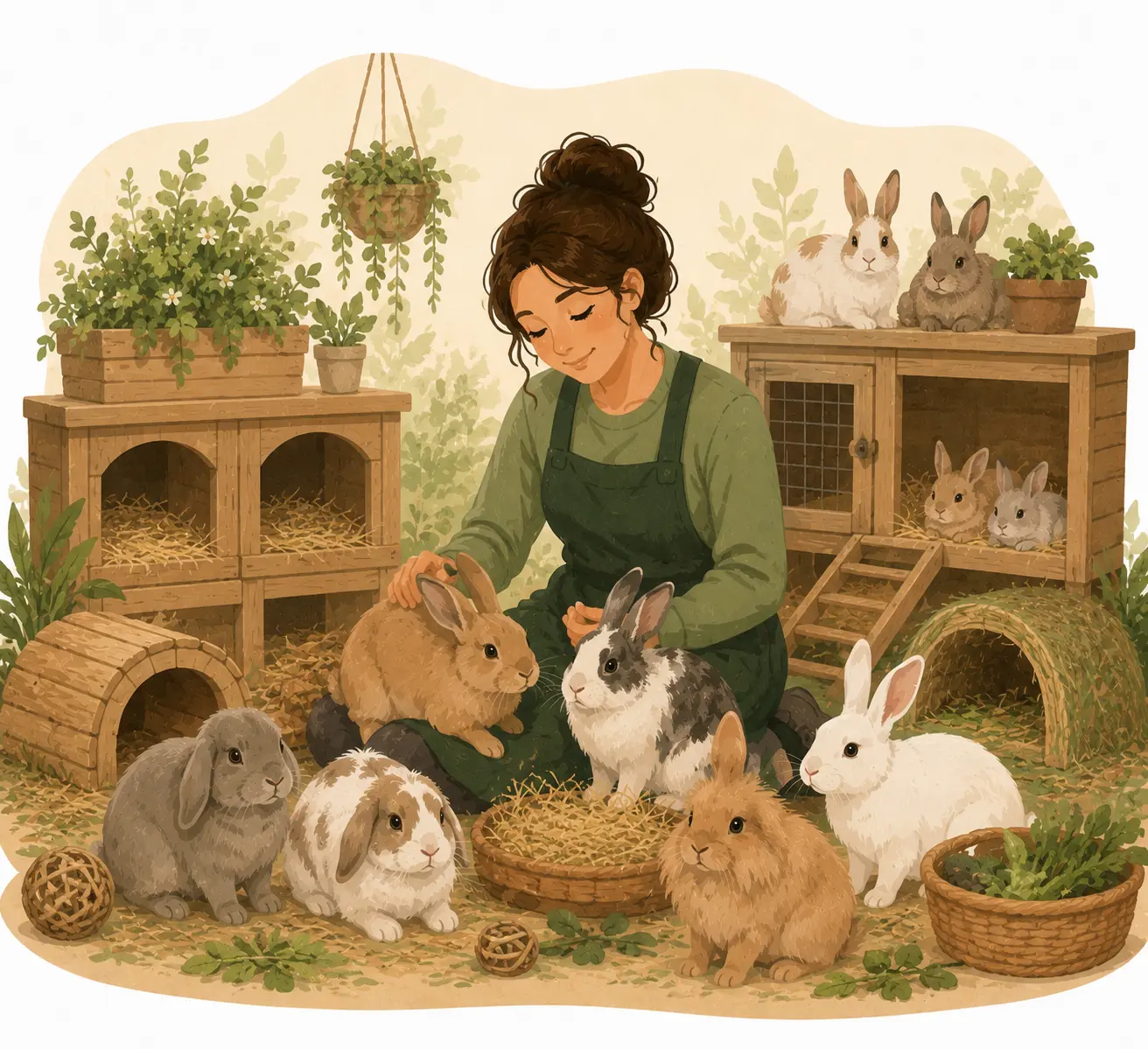
Choosing a rabbit breeder and preparing for your new companion
Welcoming a rabbit requires more preparation than simply buying a cage and a few accessories. Rabbits are active animals with specific dietary, social, behavioral and environmental needs. Before choosing a breeder, it is useful to learn about the breeds available, understand the conditions in which the animals are raised and prepare suitable living space. Prousty & Co allows you to search for rabbit breeders and discover different breeds before making contact.
How to choose a rabbit breeder
An initial conversation with the breeder can help you understand how they work, which breeds they raise and the living conditions provided for their animals. Do not hesitate to ask specific questions about the parent rabbits, young rabbits and their daily care.
A breeder should also be able to explain the rabbit’s current routine, diet, observed temperament and useful information for preparing for its arrival.
Look at breeding conditions
The conditions in which rabbits are raised are an important point to consider. Animals should have a clean environment, space, resting areas and opportunities to express natural behaviors.
Also observe the animals’ general condition and ask how feeding, housing maintenance, interaction and monitoring of young rabbits are organized.
Choosing a rabbit breed
Rabbit breeds differ in size, body type, coat and grooming requirements. These characteristics may influence the space required, grooming needs and practical aspects of everyday care.
Breed alone does not fully predict an individual rabbit’s personality. Temperament, previous experiences and living conditions also influence behavior.
Rabbits need proper living space
A rabbit needs to be able to move, run, jump, stretch, explore, rest and adopt different postures. Its living area should therefore be designed as an environment in which it can genuinely move around.
A resting area can form part of this environment, but the overall setup should provide enough room for the rabbit’s daily activities.
Prepare a safe environment
Indoors, electrical cables, unsafe plants, small objects and difficult-to-access areas may need to be secured. Outdoors, escape risks, predators and weather conditions should also be considered.
Prepare this environment before arrival rather than discovering potential hazards gradually after the rabbit has moved in.
Hay, grass and rabbit diet
Hay or grass forms the foundation of a rabbit’s diet and should be continuously available. A fiber-rich diet supports digestive function and the natural wearing of the teeth.
The diet may also include suitable leafy plants and a measured amount of supplementary feed according to the animal’s needs. Fresh water should remain available at all times.
Avoid sudden dietary changes
Before the rabbit leaves, ask the breeder exactly what it eats and how often. Initially maintaining a familiar diet helps preserve continuity in its routine.
If a dietary change is needed, it should be gradual. For a young rabbit or an animal with particular needs, seek advice from a veterinarian experienced with rabbits.
A rabbit’s social needs
Rabbits are a social species. Before adoption, ask about the rabbit’s current living arrangements and how its future social life should be organized.
However, unfamiliar rabbits should not simply be placed together without preparation. Compatibility and introduction conditions should be considered so that living together can be established progressively.
Enrichment and natural behaviors
Exploring, foraging, gnawing, hiding, running and resting are part of a rabbit’s daily life. Its environment can be arranged to encourage these behaviors.
Hiding places, tunnels, exploration areas and opportunities to forage can make the environment more stimulating. Accessories should be selected with safety and the rabbit’s actual use in mind.
Understanding rabbit behavior
Rabbits communicate extensively through posture and movement. Taking time to observe them helps you understand when they want to interact, explore, rest or instead keep their distance.
After arrival, give the rabbit time to discover its new environment. Trust develops gradually and does not require frequent handling immediately.
Handle a rabbit carefully
Not all rabbits enjoy being picked up. When lifting is not necessary, interacting at floor level can allow the rabbit to retain more control over the situation.
Ask the breeder how the young rabbit has been accustomed to human contact and how to handle it correctly when handling is necessary.
Check the rabbit before it leaves
Before taking the rabbit home, observe its general condition and ask the breeder for available information about its health history. Eyes, nose, coat, mobility, appetite and general behavior are among the things that can be observed.
These observations do not replace a veterinary examination. If you are concerned about the rabbit’s condition or if care is needed, seek veterinary advice.
Prepare for the first days at home
Set up the rabbit’s living area before arrival with water, food, hay, resting areas and hiding places. This avoids repeatedly changing the environment while the rabbit is becoming familiar with its new home.
The first few days can focus on observation and gradual exploration of the environment. Where possible, maintain consistency in feeding and routines communicated by the breeder.
Plan veterinary care
Before or shortly after arrival, identify a veterinarian experienced in caring for rabbits. This gives you a point of contact for preventive care, health questions and situations requiring veterinary attention.
Also ask the breeder which care has already been provided and which documents or information about the rabbit will be given to you when it leaves.
Questions to ask the breeder
Ask about the rabbit’s date of birth, current diet, routine, observed temperament, available information about its parents and any care already provided.
You can also ask how the young rabbits are raised, which environments they have experienced, how they interact with other rabbits and what recommendations the breeder provides for settling them into their new home.
Check applicable requirements
Rules concerning breeding, sale, identification, transport or keeping of animals may vary according to the country, region and circumstances.
Before acquiring a rabbit, check any requirements that apply in your area and which documents should accompany the animal where required.
Find a rabbit breeder on Prousty & Co
Prousty & Co allows you to search for rabbit breeders according to your location and discover the breeds offered by listed professionals.
Review profiles and contact breeders directly to learn about their rabbits, breeding practices, availability, living conditions and the information needed before acquiring an animal.